SHARING RESEARCH IN PROGRESS

Making Sense of PARNES "MESS" / ACKOFF "MESS" Today
Welcome back readers. Delighted to be making bird-by-bird progress on the construction of this Design for Complexity book. Always part of book-making is deciding what to not include as the plane has to eventually land. In those considerations, some things rise up and others fall away. What are meaningful boundaries now for this subject in motion? Some things with cascading implications are difficult to ignore.
Happy to share this brief background research clarification post in reference to a particular anomaly noticed in the historical innovation methods literature that relates directly to the subject of Design for Complexity and is often being repeated endlessly in social media, now with the help of ChatGPT.
One of the not-so-fun things about writing a book on this complex cross-community subject is that one inevitably is called upon to move beyond various inter-tribal cheerleading literatures in order to more clearly see, make sense of, and communicate the cross-community evolution picture.
In that journey one inevitably encounters in historical literature and current interpretations of that literature, various forms of competitive angling between the anchor disciplines related to Design for Complexity, described in an earlier chapter of this book as Action Research, Creative Problem Solving (CPS), Design and Soft Systems Thinking. (See RETHINKING CHANGEMAKING ARCHETYPES & RECALIBRATING HOLISM in this book.)

FIREHOSE POURING
Optimistically we wish that all anchor disciplines could sit around a campfire and be honest about what in innovation methods history came from where. We wish it was all smooth sailing in that regard with the sight lines being agreed upon, but the reality is no such campfire exists. Instead what tends to dominate today, whether we all like it or not, is high volume tribal-centric, echo-chamber, social media posting strategies. Whether postings are factually incorrect or not, the firehose keeps pouring.
It is already clear that noticeably adding to the complexity in the mix is that Ai, in particular ChatGPT, cannot be relied upon to clarify various origin related questions. Increasingly ChatGPT seems to be scraping up tribal-centric content from LinkedIn and other online sources without much discernment between fact and tribally-promoted fiction. Alternate histories, and alternate presents are being created simultaneously. Whether a fact-based history of innovation methods will survive the distortion wave being accelerated by Ai is an open question.
HIGHLY USEFUL
In this bumpy context, it is presently highly useful to have original materials present in order to undertake any kind of Root Source Analysis work. Luckily Humantific has accumulated a significant archive of early innovation related materials, readily accessible during research.
As part of working on this book, it’s true that several methods-related discombobulations have been encountered in literature. One of the most prominent and often repeated involves the misstated origins of the term “mess” in the context of problematic situations.
It's true that in 1974, internationally known scholar, organizational theorist, educator, management thought leader, consultant and systems thinking advocate, Professor Russ Ackoff used the term “mess” in his book entitled *“Redesigning the Future”.
“Managers are not confronted with problems that are independent of each other, but with dynamic situations that consist of complex systems of changing problems that interact with each other. I call such situations messes.”
That material fact is unfortunately often enhanced by the suggestion or implication that the mention/depiction of “mess” authored by Professor Ackoff was its first innovative appearance in the broad context of problematic situations. The creative depictions stretch from “first within systems thinking” to “first universally”. It is that constantly repeated shading last part that is factually untrue. That part is an overwriting false narrative, a misleading distortion of the origins timeline with numerous implications.
SCHOLARLY READERS
Our scholarly readers, not just digesting “systems” literature, but rather working across several communities of practice would recognize that the term “mess” had already appeared in another changemaking communities’ literature, many, many, many times 10+ years prior to the 1974 Ackoff book.
Thanks to the prescient work of internationally known scholar, applied creativity pioneer, educator, author, learning program designer, systemic methodology advocate, consultant, CoFounder of the Creative Education Foundation and Founder of The Journal of Creative Behavior, Professor Sid Parnes “mess” appears in multiple *CPS community publications beginning in 1959.
Oddly today, if you ask ChatGPT the question regarding origin it will repeat the incorrect 1974 crediting of systems thinking and Russ Ackoff. It will even go so far as to misstate that Sid Parnes, operating in the CPS community, “used the term messy problems, not “mess”. That is flat-out incorrect, second, third order over-writing. No wonder there is so much confusion around this subject in the systems thinking community.
This is the kind of shading/misrepresentation that does grow tiring for seasoned cross-community veterans of this subject.
HAPPY HISTORY
Happy to share this history with our readers: Among the earliest CPS publications that we have in the Humantific Collection are those dated 1959, 1963, 1966 and 1967. In those volumes and in numerous others authored by Sidney J. Parnes one can certainly not only find the term “mess” present but also being placed in an approach/methods context, that cascades forward and is built upon for subsequent decades.
Here is Sid Parnes in 1967: “You start out in any perplexing situation with a “mess”, you find the fuzzy challenges within the “mess” and then you state the challenges as broadly as possible.”
Here is Parnes in 1959: “It is only when we learn to define the specific problems in the “mess” that we begin to make progress.”
OK so that was 15 years, not months, before the Ackoff book referencing “mess” appeared.
QUICK COUNT
A quick count would suggest that the term “mess” appeared hundreds of times in numerous published CPS volumes, often designed for sharing teaching tips spanning from 1959 to 1967 including the large three volume *Sid Trilogy.
Parnes, S. (1959 & 1963) Instructors Manual, Creative Education Foundation
Parnes, S. (1966) Instructors Manual, Creative Education Foundation
Parnes, S. (1967), Creative Behavior Guidebook, Creative Education Foundation
Parnes, S. (1967) Creative Behavior Workbook, Charles Scribner’s Sons
Parnes, S. Noller, R. Biondi, A. (1976) Creative Action Book, Charles Scribner’s Sons
Parnes, S. Noller, R. Biondi, A. (1977) Guide to Creative Action, Charles Scribner’s Sons
Lets take a moment to reflect on that. For those readers who do not have access to original materials, we are happy to share here just a few early artifacts:
FIGURE A:

FIGURE B:

FIGURE C:

For those who are so-inclined, certainly numerous additional examples can be found in original materials.
SYSTEMS ARTIFACTS
If we take a few minutes to look inside the Ackoff 1974 “ReDesigning the Future” book there is no visualized process recognizing or incorporating “mess” there.
FIGURE D:
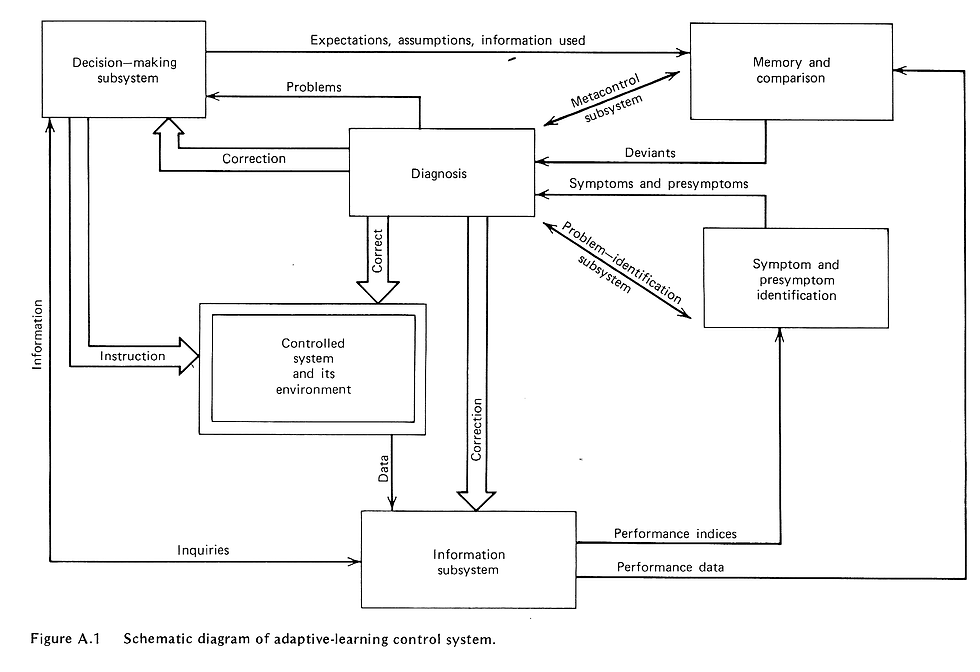
If we look inside “The Art of Problem Solving,” Ackoff 1978, there is no visualized process recognizing or incorporating “mess” there either.
FIGURE E:

CHECKLAND EARTHQUAKE
To be fair, we can acknowledge in the context of the big picture methodology evolution time-line that the 1974-1978 Ackoff books, models and use of the term “mess,” appeared before the 1982-83 *Checkland Soft Systems earthquake had arrived.
In that mid-life crisis quake for the systems thinking community it was openly declared inter-tribally (by Checkland and others) that the then current state of systems thinking, operating for 40+ years, (later coded as hard) was neither holistic or suited to complex human problematic situations.
In particular that approach assumed that the system was real, the boundaries known, the problem was given and the goal agreed to, with an aim to control and optimize.
Peter Checkland: “It became clear that structured problems are what hard systems thinking and most operational research are concerned with.”
Peter Checkland: “The development of Soft Systems Methodology during its own history has shown a shift….from the world of engineering thinking to the world of management thinking…Its parent was systems engineering, and it moved experientially from an approach aimed at optimizing a system to an approach based on articulating and enacting a systemic process of learning.”
If we check in with the Soft Systems Methodology tabled in 1982-83 by Checkland, which we included in our Innovation Methods Mapping book, one can see that there is no “mess” recognized or incorporated there either.
Checkland’s not-so-remarkable seven-phase Soft Systems Methodology begins with “Problem situation considered problematic.” Checkland envisioned a 1980s shift for systems thinking, redepicted as soft, from “problem given” to “problem situation considered problematic.”

Our editorial comments on that method, made in our 2016 Innovation Methods Mapping book: “Soft Systems literature seems to have no awareness of parallel design community or CPS community methodology knowledge.”
Often missing from the story is that the problem of being too machine-oriented, too mechanistic, not human enough was unique to the engineering-oriented systems thinking community at that time. That was not a problem that existed in the other anchor approaches; Action Research, CPS and Design.
By the time that Checkland tabled his reinterpretation of the Ackoff “mess” as “problem situation considered problematic”, the notion of “mess” had been deeply operationalized in the CPS community for 20+ years.
INTER-TRIBAL TIME WARP
Soft Systems Methodology was a significant 1980s effort by Checkland and others to migrate mechanical (hard) engineering systems thinking in the direction of the already in progress complex human/social organizational and societal transformation/ changemaking party, where Action Research and CPS were already present and had been for decades.
It’s a late migration, often depicted inter-tribally within systems literature with a little time-warping *jedi-mind trick maneuver as the creation of that party, the more macho origin of that party, rather than an arrival at that party.
To imply that no such party existed as late as 1983 until Checkland arrived with Soft Systems Methodology is a narrative that does not stand up in any cross-community conversation.
Journalistically/methodologically speaking that head-spinner seems to be a relatively untold, elephant in the systems thinking living room story.
(See APPENDIX 1 below)
SUBSEQUENT “MESS” RELATED EXTRAPOLATIONS
How the notion of “mess” was carried forward, built on or not in each of the two communities differs significantly.
In the CPS community Figure 2, the early Complexity Ladder, with ‘mess” embedded within goes on to inform the creation of what eventually evolves into *Systemic Challenge Framing, activating how to move between the levels to create systemic constellation views of challenges and how they interconnect below “mess”. This mapping operationalized how to move beyond just talking about “mess”, demonstrating via cocreated mapping that organizational/societal problems are not independent of each other, a considerable forward progression.
Integrated into the evolution of contextualization of “mess” was the creation, again by Sid Parnes, of navigation prompts (invitation stems) such as How might We? Along with moving away from discipline-based framing, and the ushering in of discipline-agnostic framing, both significant methods related innovations inspired by the surfacing and acknowledging of “mess”.
The notion of “mess” later evolved to the active “Mess Finding” by CPS scholars, Scott Isaksen and Donald Treffinger in the 1980s along with numerous other forward-motion refinements, too many to describe here.
The subsequently evolved Systemic Challenge Framing became the answer to the “so-what question” around the original notion of “mess.”
There is no Systemic Challenge framing in Action Research, Design or Soft Systems Thinking methodology, unless it has been imported from CPS.

SCANNING “MESS” ACROSS 80+YEARS
If we check in further with the 60+ methods included in our first book, Innovation Methods Mapping, Demystifying 80+ Years of Innovation Methods Design it becomes clear that “mess” as a starting point is typically not found in design methods during the examined 80 year period. Most design methods tabled during that time begin with the assumption of an assigned problem.
Today methodology scholars recognize that the deliberate inclusion of “mess” embedded on the front end of an innovation process is often an indicator of CPS methodology awareness and knowledge.
Today one can see several next generation approaches appearing in this book incorporating the Parnes-inspired Systemic Challenge Framing, moving away from discipline-based framing. See RETHINKING FRAMING in this book.
BROADENING & NARROWING
For those interested in the broader methodology context; The accompanying approach mechanics around the notion of “mess” in the Parnes approach and the Ackoff approach were/are significantly different.
Noticeable is that Parnes projects a widening approach where 1. (inspired by the war) everyone participates in problem finding and cocreation which involves 2. equal measures of divergent and convergent thinking and 3. equal valuing of both.
Ackoff projects an approach where readers are told that “managers” do the solving of problems and the importation of privileging management-oriented “decision-making” (not recognized as convergent thinking) was/is foundational.
ACKOFF 1974
Russ Ackoff in Redesigning the Future 1978: “A problem, as I conceptualize it, has five types of components.
1.The ones(s) faced with the problem, the decision makers(s).
2. Those aspects of the problem situation the decision maker can control.
3. Those aspects of the problem situation the decision maker cannot control but those which together with the controlled variables can effect the outcome of his choice, the uncontrolled variables.
4. Constraints imposed from within or without on the possible values of the controlled and uncontrolled variables.
5. The possible outcomes produced jointly by the decision markers choice and the uncontrolled variable.”
“Using the conception of a problem set forth above we can consider problem solving with respect to what the decision makers do about each of the following.
Objectives, 2. Controlled Variables, 3 Uncontrolled Variables, 4. the Relationship Among the Three.”
“Management involves decision making and decision making involves problem solving whenever the decision maker is in doubt about the choice to make.”
PARNES 1967:
Here is Parnes 11 years earlier in Guidebook 1967: “Obviously there is an urgency for developing in people the ability to live with constant change in a dynamic society.” Problem solving may be considered the process of human adaptation to cultural life. Creating deliberate means of treating perplexing situations is therefore an opportunity, a challenge.”
It’s no secret that both the Parnes and Ackoff approach orientations have well-known MASSIVE implications in the context of cocreative Arena 3 and or Arena 4 interventions and culture building. See INBOUND/OUTBOUND in RETHINKING HOLISM in this book.
BOTH SCHOLARS / VERY DIFFERENT VIBES
Sid Parnes: “Mess” arrival: 1959-1964 (CPS / Applied Creativity Community)
Russ Ackoff “Mess” arrival: 1974-1978 (Hard Systems Thinking Community)
CLOSING / SPEAKING UP
What troubled me most about this underlying, relatively untold story was the ongoing aggressive overwriting present in plain sight in social media, in particualar on LinkedIn 24/7. As if the presumptive, repetitive overwriting was not bad enough, the expansive regurgitation by ChatGPT was for me, a spin bridge too far.
On the question of how might one tribe lose the true value and contributions of its community history, one answer is that it lets others on the play-ground over-write it without speaking up.
In the atmosphere of today, not everyone has the equipment, the inclination or the journalistic platform to speak up, so I feel a certain degree of obligation to do so. The tribe being overwritten in this example is one of several that we know deeply, respect and participate in. All things considered I am happy to have tabled this clarification document.
Some of what we have seen and discovered while writing this still-in-progress book suggests to me that this will probably be my last book on this subject.
Famously and with a sense of humble humor Sid Parnes wrote in 1967: “Within five years, about one-half of what I have told you will either be untrue or not worth a darn. This doesn’t really bother me; but what does irritate me is that I can’t even tell you which half is which.”
Today, fifty+ years later, the half that was/is most important, most enduring, can more clearly be placed in perspective.
Finally, why the "mess" story is important is because it relates directly to the foundational assumptions of operating in Arena 3 and Arena 4 and that is entering situations without assuming the problems are known, entering without approaches/methods that have such assumptions baked in.
That criteria would eliminate not only hard systems thinking but most of the design process models created before 2005. Essentially that is the challenge and the opportunity facing the community in this age of High Complexity/High Uncertainty.
BIG THANKS
Big thanks to Sid Parnes and Russ Ackoff for their many contributions to the evolution of not just changemaking philosophies, but ALSO actual methodologies.
End.
APPENDIX 1
CENTRAL PERPLEXITIES
Wanting to stay on track with the “mess” story it was not journalistically possible to fit all the various layers of methods-related intrigues, ironies, jedi-tricks, perplexities and intertwined forward motions occurring in the 24 year period from 1959 to 1983.
Having said that, we could not help but notice, in the big picture sense, that running in parallel to the 1. “mess” redepiction story was 2. the "mid-life crisis hard/soft story", 3. the subsequent "Checkland earthquake story", and finally 4. the “takes the cake” story, all layered into the mix.
Among the most ironic head-spinners noted in the time-line of that combo was the appearance of advice being served up to organizational leaders suggesting that they should shift from the “machine age” metaphor to a new age being framed as the “systems age”, this occurring at a time when the deeply rooted, mechanistic hard systems approach was prevalent in that community. That takes balls to pull that one off. That little jedi dance step takes the cake!
Our research would certainly suggest that each of the anchor approach literatures have their own personalities, communication styles and marketplace behaviors. Some play well with others in think-blending and some present significant challenges.
While each of the anchor approaches had/have their own trials and tribulations, there is no equivalent to the mistating "mess", "mid-life crisis", "earthquake" or “takes the cake” stories in any of the three other anchor disciplines/ approaches, Action Research, CPS and Design.
SUMMARY / THREE CENTRAL PERPLEXITIES
Perplexity 1: The notion of “mess” in the context of organizational and societal problematic contexts did not originate with Russ Ackoff or systems thinking.
Perplexity 2: The notion that the organizational and societal changemaking party did not exist until 1982-83 with the arrival of Soft Systems Methodology is a false narrative.
Perplexity 3: None of the other anchor approaches identified in this book, Action Research, Creative Problem Solving and Design faced a mid-life crisis due to not being human-centered.
These perplexities are seldom made clear in the current soft systems narratives being tabled 24/7 on LinkedIn and other social media, (now being rerepositioned as systems thinking) and vacuumed up by Ai, thus there tends to be considerable public confusion around these subjects. Much of the confusion-making is rooted in the systems thinking community itself.
NOTES TO READERS
*Redesigning the Future / Crediting: One might wonder if the CPS community, its earlier published methods-related knowledge, or Sid Parnes were cited in the back of Ackoff’s 1978 Redesigning the Future book. The answer is no. This holds true to other truncation examples seen in the often self-referencing systems literature. In academic style those who did get included in references by Ackoff in the Redesigning the Future book are Socrates, Issac Newton, Descartes, Albert Einstein, Sigmund Freud, Alexander Graham Bell, John Dewey, and Churchman. One does wonder if the crediting style of the earlier systems thinking community pioneers has cascaded forward into today. Enough said on that one.
*Sid Trilogy: This is a term created years ago by Humantific to describe the large 3 volume set of CPS Parnes books including “Creative Behavior Guidebook” 1967, “Creative ActionBook” 1976 and “Guide to Creative Action” 1977. In the later 2 volumes Parnes collaborated with Ruth B. Noller and Angelo M. Biondi. Inside Sid Trilogy in a mixture of elementary and advanced states, are what amounts to the foundations of all Applied Creativity / CPS workshops. Parnes being an educator at heart, the volumes lay out an entire skill-building program. Pedagogically speaking, there is no equivalent to the Sid Trilogy in Action Research, Design or Soft Systems Thinking.
*CPS community: CPS is the USA-based Creative Problem Solving community also known as the Applied Creativity Community. Its methods oriented literature begins in the 1940s. CPS had its first public methods oriented conference in 1955. It’s evolution is ongoing and its knowledge appears in numerous other communities of practice, via Think-Blending including the design community.
*Sharing Teaching Tips: By the mid 1960s the CPS community had considerable methods-related knowledge codified and in workshop delivery form. Many of the experiential thinking related exercises seen in Sid Trilogy are still incorporated into various forms of design and innovation skill-building workshops today. Many of the most fundamental thinking related exercises were built while embracing Guilford Turn.
See "RETHINKING BEHAVIORS : Making Sense of Lewin and Guilford today" in this book.
*Systemic Challenge Framing: As we pointed out in the Rethinking Framing Chapter many scholars contributed to the evolution of what began as Figure 2, evolved into abstraction ladder, and eventually became System Challenge Framing. See DEEP EVOLUTION in the ReThinking Framing chapter of this book. Those contributing early scholars include S.I. Hayakawa, A. Korzybski, Sid Parnes, Scott Isaksen, Brian Dorval, Min Basadur, Don Treffinger and others. There are no equivalents to the Systemic Challenge Framing in Action Research, Design or Soft Systems Thinking.
*Jedi Mind Tricks: “The Jedi mind trick” refers to a fictional mental technique from the fictional Star Wars film series universe that lets a Force user subtly influence, persuade, or overwrite another person’s short-term beliefs and actions. In popular culture it’s become a shorthand for any clever psychological nudge that causes someone to do what you want without overt force…implanting suggestions to bypass obstacles, gain information, or ensure compliance. “
GRADUATE STUDENT METHODOLOGY EXERCISE
Any graduate or postgraduate student discussion groups focused in the direction of studying innovation methodologies and related pedagogy would benefit from conducting an informal comparative analysis of these two books, published twenty years apart, one Parnes 1967 and the other Ackoff 1987. Students could consider and discuss: What is the state of codified methods-related knowledge in these two volumes and what is the role of “mess”.


RELATED CHAPTERS
REFERENCES
Ackoff, R, (1974) Redesigning the Future.
Ackoff, R, (1978) The Art of Problem Solving.
Ackoff, R. Wardman, K. “From Mechanistic to Social Systemic Thinking”
Parnes, S. (1959 & 1963) Instructors Manual, Creative Education Foundation
Parnes, S. (1966) Instructors Manual, Creative Education Foundation
Parnes, S. (1967), Creative Behavior Guidebook, Creative Education Foundation
Parnes, S. (1967) Creative Behavior Workbook, Charles Scribner’s Sons
Parnes, S. Noller, R. Biondi, A. (1976) Creative Action Book, Charles Scribner’s Sons
Parnes, S. Noller, R. Biondi, A. (1977) Guide to Creative Action, Charles Scribner’s Sons
This is a book in progress. Stay tuned.


This post offers an incredibly fascinating read. Your breakdown of historical linguistic evolution gives readers an exceptional understanding of how language shifts over time.
As someone who frequently provides online finance case study help I find this deep analytical research highly valuable for creating richer academic papers. It provides great context that helps make modern writing much more impactful and engaging.
This post offers an incredibly fascinating read. Your breakdown of the word's background and historical evolution gives readers an exceptional understanding of how everyday language shifts over time.
As someone who frequently assists students looking for write my essay London I find this deep linguistic research highly valuable for creating richer academic papers. It provides great context that helps make modern writing much more impactful and engaging.
nice post keep it up!
sustainable data center in saudi arabia
Really helpful post! One thing I was curious about do you have any advice for Stem Cell Treatment In Marina Del Rey? Would love to hear your thoughts.
This blog is very interesting. Your explanation of the word "mess" demonstrates its early usage together with its historical development. The post enables readers to achieve deep understanding of the content. I frequently search for write my essay for me canada which this research provides valuable information.