RETHINKING FRAMING 1
Updated: Aug 17

Making Sense of Open Systemic Challenge Constellations
One of the most difficult things to be journalistically doing around the subject of strategic design today is to be stating notions contrary to the accepted orthodoxies, often driven and held dearly by the graduate academic institutions. In this book a practice-informed contrarian shift tends to be tabled in virtually every chapter so we are well aware that there are probably, for some, numerous bumps in the road here.
Several of those context and methods related shifts present quiet or loud challenges/opportunities to Arena 1 and Arena 2 focused practices, as well as current graduate design education, specifically those programs seeking to equip students to tackle the complexities of Arena 3, organizational changemaking and Arena 4, societal changemaking.

In this book we are pointing out that there is not one Design for Complexity method, while taking the time to share with readers several forks-in-the-road type opportunities, or think-blending opportunities, however you might like to think about it. The overall focus of this book and this chapter is widening the aperture, and pointing out skills that will aid in the widening of view-making in practice, a central necessity in tackling complex situations.
In this chapter we return to considerations of Skill-to-Scale in the context of Design for Complexity and fold in one key in making the journey from Arena 2 to Arena 3 and Arena 4. That key is being open to the possibility of shifting beyond the single strand of discipline-based framing.
In recognition of Einstein-quote-overload, we decided that it was not necessary in this chapter to mention how Albert said he would spend that last hour to save the world..:-) Many of our practitioner readers are certainly aware of the important role that challenge framing now plays in a world facing often entangled messes. Whether engaging in the Future Casting or Strategic Intervention versions of Design for Complexity the framing of challenges inevitably comes into play, sooner or later.
With the design “brief” era looking rather tired, limiting and out of sync with holistic thinking in the face of relentless VUCA, one might ask: Are the disciple-based framing methods taught for decades in the graduate design academies up to the complexity and fuzziness now facing collective us? Has the logic and utility of the discipline-based framing procedure been outlived?
WRINKLE IN THE ROAD
It is certainly a question long percolating in the emerging Design for Complexity practice community. Opening the aperture of cross-community Think Blending/Weaving has presented some useful alternatives for those practitioners so inclined.
There is however, a wrinkle in the road here. Fundamental to opening up to the recalibration of challenge framing is one of the most basic, but controversial insights that became even more clear in the research for this book and that is that the community of practice making the transition, making the journey to Arena 3 and Arena 4 is not Action Research, not CPS (Creative Problem Solving) and not Soft Systems Thinking, but rather Design.
Take a moment and reflect on that. It is the Design community that has been *primarily focused in the activities of Arena’s 1 and 2 for decades, amounting to the vast majority of Design’s history and literature. (See *Primarily Focused in *NOTES TO READERS below)
Journalistically pointing out this realization tends to run contrary to much of the design community literature and folklore, but what that narrative is often counter-productively doing is blocking, often with considerable hostility, view into the neighboring communities that have already been operating in Arena 3 and Arena 4, in some cases for many decades. In this book we want to be clear that it is not that the Arenas 3 and 4 are new, but rather the arrival of Design with actual methodologies into those Arenas undergoing considerable recalibration that is new. This insight might not line up with some of the narratives coming from the graduate design academies.
Readers who have been reading a lot of design community marketing literature might have a difficult time processing this chapter.
TWO WORLDS OF FRAMING
It was around 2005 that we began, in the context of NextD Journal, writing about how challenge/opportunity framing changes in the transition from Arena 1 and 2 logic to Arena 3 and 4 logic. In that year we made/published one of our very first NextD Journal posters designed to signal the difference between the discipline-based framing still taught in most design academies and open framing.
The former is typically embodied in one-off briefs, often generated outside the design team or generated in a discipline-based manner by the design team. The latter is embodied in visualized constellations of interconnected challenges cocreated by multiple participants, not tied to any particular discipline. These are two very different worlds of framing.
It's probably not possible to overstate the vast investment that the graduate design academies have made in discipline-based framing. We have even seen new design books popping up claiming that discipline-based framing is THE super power of design / design thinking! :-) That is difficult music in the face of the peculiarities that we know to exist in Arena 3 and 4.
(See RETHINKING WICKED Parts 1& 2 in this book.)
DISCIPLINE-BASED FRAMING
It's not so easy to be pointing out that in discipline-based framing a product designer recognizes, frames and addresses product related challenges, a service designer recognizes, frames and addresses service related challenges and an experience designer recognizes, frames and addresses experience related challenges. These are long-held discipline orientations taken for granted, but seldom clearly articulated by the academic institutions. These are orientations that do not scale well beyond Arena 2.
Let’s consider a small hypothetical story: Imagine there is a highly energized design team, fresh out of graduate design school arriving in your community or one nearby where you live. Would it make sense if they arrived and in the meeting with community leaders said that they were there to help the community tackle its most difficult challenges BUT everything had to be converted to a product, service or experience challenge/solution. Would that make sense?
Common sense suggests no, but from a methods perspective, this is essentially what many of the graduate design academies continue to teach. Discipline-based framing is assumption-boxed.
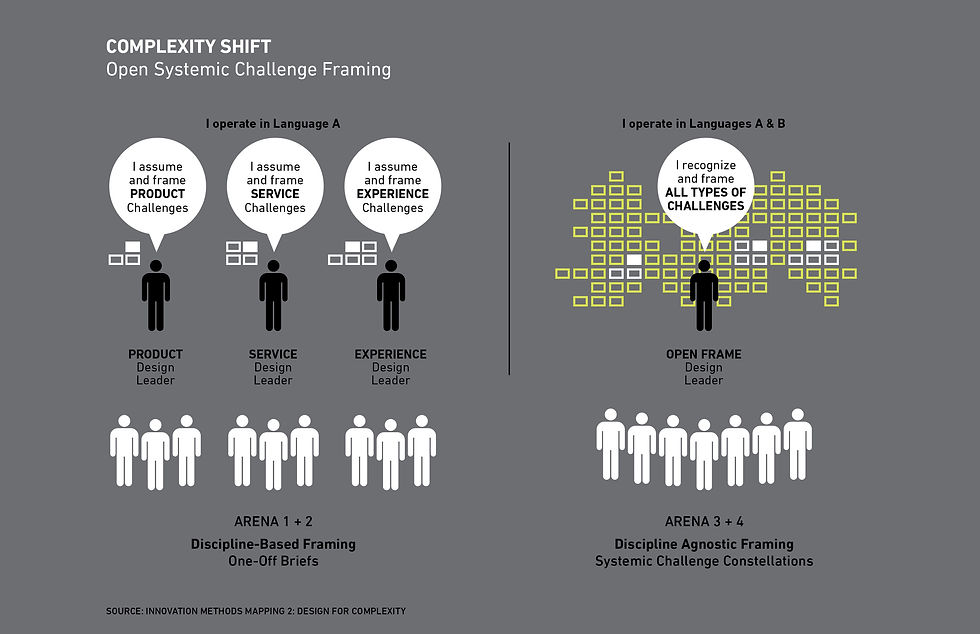

OPEN SYSTEMIC CHALLENGE FRAMING
The good news is that the limitations of inserting assumption-boxed, discipline-based framing into complex organizational and societal contexts has been overcome in the emerging Design for Complexity practice community via the adoption and fleshing out of Open Systemic Challenge Framing. (See *Deep Evolution in *NOTES TO READERS below.)
The power of Open Systemic Challenge Framing breaks those discipline-based handcuffs in order to better reflect the requirements of the complexity arenas, organizational changemaking (Arena 3) and societal changemaking (Arena 4).
The kicker is that it is a form of systematic map-making not found in Soft Systems Thinking, Action Research or Design Thinking.
What Open Systemic Challenge Framing does via cocreation is create systemic views, not of solutions, but rather of how challenges are interconnected, typically across the spectrum from simple, to complicated to complex…all in one. Systematically widening the view above, below and adjacent to any starting point. In visualized constellation form these are often, for organizational leaders, never-before seen sensemaking pictures. (See *Constructing Constellations in *NOTES TO READERS below.)
Integrated into holistic changemaking processes Open Systemic Challenge Framing becomes an important outbound tool in the complex cocreation toolbox.

You might find this framing being embedded in some Systemic Design oriented Design for Complexity approaches (and perhaps not clearly identified) but it originates in the CPS community and it’s most significant, detailed knowledge remains there today.
Do misunderstandings regarding challenge framing in general often bubble up in various literatures and discussion threads? You Betcha.
A few examples of what is NOT Open Systemic Challenge Framing:
Not sketching diagrams of “human activity systems”
Not root-cause analysis
Not mind-maps
Not causal maps
Not zooming (See Powers of Ten / Zooming below)
Not making giant digital maps of situational ecologies
Those activities might inform Open Challenge Framing but they are not one in the same.
SYSTEMIC SYSTEMICS
Packing a significant punch, this form of framing does not stand alone but rather marries up in systemic ways with: 1. the realization that everyone sees challenges/opportunities and systems in different ways, 2. the previously mentioned differentiating content knowledge from process knowledge, 3. differentiating divergence from convergence, 4. the invitation stem system of “How Might We?” (also originating in the CPS community) and 5. visualization.
Open Systemic Challenge Framing begins as a divergent participatory exercise. Ultimately it generates a challenge field from which a course of action can be made. Open Systemic Challenge Framing is an emergent, real-time form of Visual SenseMaking. (See the RETHINKING SENSEMAKING chapter in this book.)
This form of challenge framing tends to be a good fit with approaches that are high in cross-disciplinary participation and not a great fit if you are driving a tell-tell, sage-on-the-stage model. Open Systemic Framing tends to unpack, dissolve and present an alternative to both assumption-box orientation and the sage-on-the-stage engagement model.
DOORWAY TO META
Let's reflect for a moment, in the big picture sense, on what this shift actually is; It’s essentially a doorway. Open Systemic Challenge Framing is the key to the doorway between traditional discipline-based design and what is often called meta design. If meta implies the ability to frame beyond your discipline assumptions….This is key. Difficult news: It’s not possible to reach meta in discipline-based framing mode.
From a complexity lens perspective, it does not make a whole lot of sense to be talking up complexity, cross-disciplinary cocreation, systems thinking and emergence while engaged with discipline-based, assumption-boxed framing. The emerging Design for Complexity community strives to be doing better on the other side of that doorway.
CLOSING
We might ask ourselves: Who cares and why does it matter?
1. Disadvantaged: A case could certainly be made that we would be putting the arriving generation of design leaders at a significant disadvantage if we dispatched them to face the ever evolving complex challenges of Arena 3 and 4 equipped only with traditional discipline-based, assumption-boxed framing skills. It's difficult to imagine the realization of a new culture of meta design while continuing to depend on traditional discipline-based framing.
2. Disconnected: As parts of the Design for Complexity community diversify away from discipline-based framing there tends to be an erosion of synchronization with the framing being taught in the graduate design academies. Where that leads to is the practice community setting up their own academies to bridge the methods gap. Whether everyone likes it or not this is already occurring, has already occurred.
3. Time Has Run Out: A tremendous amount of time has already been consumed with trying to force-fit discipline-based skills into increasingly complex contexts. Now, taking into consideration the state of the world it becomes more clear that time is pressing our communities and planet earth. The period when the design community had endless amounts of time to argue and defend discipline-based framing is rapidly closing, some readers might suggest it is already over. A more systemic way to cocreate and share what the challenges actually are makes for a timely addition to several not all Design for Complexity approaches seen in this book.
It’s not that difficult to make the case that personally on-boarding Open Systemic Challenge framing increases your adaptive capacity, increases your strategic value, increases your ability to work upstream from briefs. This a skill that allows you to go out into your complex organization and help anyone, any group, any team. That’s not a terrain that everyone is built for but it is the terrain of Design for Complexity.
Every Design for Complexity Strategist that we know of has, or is taking a serious look at rethinking the thinking around traditional notions of framing, now in the context of the complexity arenas. (See also RETHINKING COMPLEX COCREATION FACILITATION and RETHINKING “WICKED” Parts 1 and 2 in this book.)
While framing continues to be a central component in R&D programs for some Design for Complexity practitioners, not all have Open Systemic Challenge Framing on their Design for Complexity train…:-)
End.
*NOTES TO READERS
*PARALLEL UNIVERSES / TIME LINES
In this kind of story we are always interested in the broader context. When it comes to challenge framing we want to take a look at and share what was occurring in parallel communities of practice as expressed in various literatures. It is acknowledged that prior to the arrival of the internet the various change related communities of practice were comparatively isolated from each other.
As an example See NextD Journal: 2007, Buffalo/Berkeley Divide.
Parallel Universe 1 / Berkeley, 1972
It is no secret that the change/intervention communities in Buffalo and Berkeley were largely disconnected islands at that time. In a parallel universe, operating on a different R&D timeline, with different contributors, university professor Horst Rittel (1930-1990) (Berkeley School) introduced the term "wicked problems" in 1972. As far as we can determine, there was no logic related to creating systemic views of challenges in Rittel's "Generation 1" process. There is literally no Framing phase in that 8 phase process which we included in our first Humantific book, Innovation Methods Mapping / De-Mystifying 80+ Years of Innovation Process Design.
See also RETHINKING WICKED: Parts 1&2 in this book.
Parallel Universe 2 / Ackoff, 1978
In another parallel universe running on a different R&D time-line, engineer, author, consultant and teacher extraordinaire, Russ Ackoff (1919-2009) exclaimed that "problem solving is what I have been trying to do all my life." Ackoff published "The Art of Problem Solving" in 1978. As far as we could tell, there was no logic related to creating systemic views of challenges in Ackoff's "The Art of Problem Solving" approach.
Parallel Universe 3 / Soft Systems, 1980s
In yet another parallel universe, operating on a different R&D timeline, Systems Thinking pioneer, Peter Checkland blew-up the so-called Hard Systems Thinking approach and introduced "Soft Systems Methodology" circa 1981. Not reflective of already existing CPS knowledge, as far as we could tell, there was no logic related to creating systemic views of challenges in Checkland's "Soft Systems Methodology" which we also included in Innovation Methods Mapping / De-Mystifying 80+ years of Innovation Process Design.
Parallel Universe 4 / Design
Since we also wrote a sensemaking and rethinking oriented book on the subject of design / design thinking in 2020 we are pretty sure that discipline-based framing continues to dominate most forms of design being taught in the graduate design academies as described in this chapter. Bravo to any graduate design school that has transitioned.
We do note that the Eames office published the beloved "Powers of Ten", in 1968, one of the most imporant short films in the history of design. The film shows a visualized version of altitude alteration and its impact on perspective. What happens in the film has come to be known as "Zooming in and Zooming out".

To be clear: "Zooming" is largely a conceptual fly-over. “Zooming” provides no methodology for participants to cocreate challenges at various altitudes. Zooming is conceptual. Systemic Challenge Framing is strategic. Both are useful but do very different things.
Other parallel universes always seem to exist...:-)
*Challenge Constellation Construction is participatory, not generated via the Sage-on-the-Stage model. For implications for design leadership and the hero model see RETHINKING COMPLEX COCREATION FACILITATION in this book.
*Primarily Focused: Among the 60+ methods spanning a period of 80+ years that we included in our first book Innovation Methods Mapping, were those created by Bruce Archer 1964, John Chris Jones, 1970 and Horst Rittel 1972. Relative to where the vast majority of the design community was focused at that time, those were contrarian leaders. Was that the original design community "fight club" for advocating awareness of rising complexity in the context of design? Some might say so. Readers can decide for themselves if those methods tabled in Era 5-6, represented significant philosophical or methodological contributions along the cross-community time-line of Innovation Methods Evolution that we included in the Methods Mapping Book. Archer method page 87, Jones method page 93, Rittel method page 99. The Jones method referred to "brief issued", and the Rittel method "understand the problem". John Chris Jones in particular was a strong advocate of the then design community rethinking its relationship to complexity as part of the Design Methods Movement. He eventually turned in *another direction. Among the questions that a prescient John Chris Jones tactfully tabled in his 1970 book entitled "Design Methods" were: "How do traditional designers cope with complexity?" and "Why are the new kinds of complexity outside the scope of the traditional design process?" It was a topic of struggle for many in the design community at that time. Now 50 years later it remains a challenging subject. Standing on the shoulders of many previous contributors, today there is even greater need to make some significant progress beyond philosophy, towards tangible methods while some in the community still struggle with basic problem-finding/acknowledgement in this subject.
*For more info on the other direction that John Chris Jones took after departing the Design Methods Movement see NextD Journal #26: (2006) Double Consciousness, GK VanPatter & John Chris Jones
*Deep Evolution: Where did Open Systemic Challenge Framing come from? Not intending this to be a history book we can certainly share that it has a long deep evolutionary history. It is itself a product of cross-community think blending and adaptation.
The notion of extracting different levels of abstraction can be traced to the scholarly “Abstraction Ladder” work of semantics scholar S.I. Hayakawa in the 1930s, which was inspired by the earlier "Structural Differentiator" work by philosopher, independent semantics scholar, A. Korzybski circa 1920s. The logic was adapted and first transported into intervention contexts by the CPS community in the 1950s and then rebuilt and rebuilt accross decades.

In a 70+ year period, considerable evolutionary heavy lifting was provided to transport these ideas to the major leagues, primarily by various pioneers in the CPS community including Sid Parnes, Scott Isaksen, Brian Dorval, Min Basadur, Don Treffinger and others. The Ladder of Abstraction's long R&D history spans numerous expansions, repurposing, context evolutions, realizations, rethinks, tweaks, name changes, and evolutions. In that history is both the analogous “Bessie the Cow story” and the ”Mousetrap story” now understood in more strategic contexts.
Integral to the mechanics of how Systemic Challenge Framing works, broadening and narrowing challenges is the device known as the “How Might We? invitation stem, also created in the CPS community and integrated into this framing. Combined they form a formidable, discipline agnostic, framing mechanism.
Having undergone many evolutions since it first appeared in rudimentary form Systemic Challenge Framing remains an active, evolving work in progress for many enlightened practice leaders engaged in cocreating framing within organizational and societal changemaking contexts.
(For more historical detail see Humantific Journal: Origins of Systemic Challenge Framing: Ten Key Milestones in REFERENCES below.)
REFERENCES:
Kodish, B. (2011). “Korzybski, A Biography”,
Hayakawa, S.I, (1939). “Language in Thoughts and Action”
Guilford, J.P. (1967). “The Nature of Human Intelligence”
Parnes, S., (1967). “Creative Behavior Guidebook”
Jones, J.C., (1970) "Design Methods: Seeds of Human Futures"
Rittel, H. W., & Webber, M. M. (1973). "Dilemmas in a General Theory of Planning"
Ackoff, R. (1978). "The Art of Problem Solving"
Checkland, P. (1981). “Systems Thinking, Systems Practice”
Checkland, P. Scholes, J. (1999). “Soft Systems Thinking Methodology in Action"
VanPatter, G.K., Pastor, E. (2016) "Innovation Methods Mapping: De-Mystifying 80+ Years of Innovation Process Design"
VanPatter, G.K., Pastor, E. (2020) "Rethinking Design Thinking: Making Sense of the Future That Has Already Arrived"
IN THIS BOOK SEE:
RETHINKING WICKED PART 1: Making Sense of EveryDay Complexity / In-Between Space
This is a chapter in progress being shared prior to the books publication.


rr88 trang chủ khiến tôi chú ý đến cách các khu vực được sắp xếp ngay trên màn hình đầu tiên. Tôi quan sát menu và thứ tự tiêu đề để xem người dùng có thể xác định nhanh từng danh mục hay không. Các nhóm nội dung được tôi kiểm tra về khoảng cách và ranh giới hiển thị nhằm tránh cảm giác chồng lấn. Sau đó, tôi chuyển sang tài khoản và hỗ trợ để xem những chức năng này có được đặt ở vị trí riêng. Nút quay lại cũng được tôi theo dõi trong quá trình điều hướng. Việc giữ cấu trúc quen thuộc giúp tôi dễ ghi nhớ vị trí và trở về trang chính sau…
mm88today khi kiểm tra khu vực Xổ số, tôi tập trung vào khả năng phân biệt dữ liệu theo từng nhóm và từng thời điểm. Tôi mở những nội dung liên quan đến xổ số truyền thống, xổ số nhanh, Keno và các phần kết quả được trình bày rồi quan sát cách đặt tiêu đề. Nếu ngày, kỳ và loại dữ liệu được thể hiện rõ, tôi có thể xác định mình đang xem thông tin nào mà không phải đọc toàn bộ trang. Tôi tiếp tục chuyển qua lại giữa kết quả và thống kê để xem hai loại nội dung có được phân tách dễ nhận biết không. Sau đó, tôi quay lại một mục trước đó để…
https://sunwinc.city/ cho tôi một góc quan sát thiên về mật độ thông tin khi bắt đầu từ danh sách sự kiện rồi mới đi sâu vào từng lựa chọn. Tôi thử chuyển qua nhiều giải để xem cách hệ thống phân cấp môn đấu, trận và dữ liệu liên quan. Đến giữa hành trình, Ngoại hạng Anh, Champions League, NBA và Esports giúp tôi nhận ra mỗi nhóm cần cách trình bày khác nhau nhưng vẫn nên giữ logic điều hướng chung. Tôi cũng chú ý bảng kèo Châu Á, Châu Âu và Tài Xỉu được đặt thế nào để dễ quét. Việc giữ cấu trúc ổn định giúp tôi chuyển giữa nhiều sự kiện mà ít phải định hướng lại…
rr88z.dev làm mình chú ý hơn đến cách một phiên được duy trì khi mình chuyển từ nội dung sang phần tài khoản. Mình thường đi qua vài khu vực trước rồi mới kiểm tra chức năng cần thiết để xem đường quay lại có dễ xác định hay không. Có lúc mình bắt đầu với Nổ hũ, chọn Kho Báu Sâu Thẳm rồi chuyển sang Thể thao để theo dõi quần vợt. Các trò từ Pragmatic Play và PG Soft tạo một kiểu thể hiện ở Nổ hũ, trong khi nội dung từ Saba Sports và SBOBET lại có cách sắp xếp khác. Sau đó mình vào phần đăng nhập và thông tin tài khoản. Những mục này được tách…
rr88 com làm mình để ý nhiều hơn đến cách các nội dung nhỏ được đặt bên trong từng lớp thay vì xuất hiện rời rạc. Mình thường bắt đầu từ hướng lớn rồi mới đi sâu theo phần đang quan tâm. Trong Thể thao, Bóng đá mở ra những nội dung như Ngoại hạng Anh và Cúp C1, còn Quần vợt lại dẫn đến Grand Slam hay ATP Tour. Mình thấy cách thể hiện này giúp từng dữ liệu nhỏ có bối cảnh rõ hơn và cũng tạo các điểm dừng tự nhiên cho mắt. Khi muốn thay đổi bộ môn, mình chỉ cần quay về lớp quen trước đó rồi chọn hướng khác. Sau vài lần sử dụng, quá…