COMPLEXITY OPPORTUNITIES
Updated: Jul 30

Making Sense of Complexity-Fluency vs Complexity-Capability
Continuing my conversation with *Claude Winkler. In this chapter we wade into several interconnected subjects related to Advancing Design for Complexity, via acknowledging and making sense of current marketplace vibes, spins, truths, contradictions, strengths, weaknesses, creative redepictions, disconnects and opportunties for forward motion, always keeping in mind this is intended to be geared in the direction of fellow Arena 3 & 4 emerging practice leaders. Its true, some have been "emerging" in this space for more than a decade! Others are just arriving.
G: Today lets do some work in the direction of Science of Complexity, Theory of Complexity. There seems to be a considerable disconnect, or gap between Theory of Complexity and what we call the Everyday Complexity of working in Arena 3 and Arena 4. Let's reflect on how we might define the nature of that gap and what it means for everyday innovation enabling practice in Arenas 3, organizational changemaking and Arena 4, societal changemaking.
C: I suspect the real answer is that it's not one gap but a stack of them. Let me lay out several candidate axes for the gap.
1. Object of study vs. situation of action
Theory of Complexity — *CAS research, Santa Fe-style modeling, chaos/nonlinear dynamics, *Cilliers' critical complexity — treats complexity as a property of a system being described. The theorist or modeler stands (or claims to stand) outside the system, externally observing emergence, feedback, attractors, phase transitions.
Everyday Complexity in Arena 3/4 is a property of a situation one is inside of and acting within. The practitioner is not modeling the system from outside; their framing choices, interventions, and political moves are themselves perturbations that co-constitute what happens next.
This is the classic external observer — internal participant problem, but it's not incidental to Arena 3/4 work — it's constitutive of it. A theory built on the external observer stance will always underfit a practice built on the participant stance.
2. Portability of vocabulary vs. portability of capability
This is where I think your rhetorical-weaponization concern connects most directly. Concepts like emergence, self-organization, edge of chaos, feedback loop travel extremely well — they fit on a presentation slide, they sound authoritative in a workshop, they can be taught in an afternoon. But the operational competence required to act well under real complexity (framing under pressure, holding incommensurable stakeholder framings open rather than collapsing them prematurely, reading political timing, tolerating irreducible ambiguity without manufacturing false closure) does not travel at anything like the same speed.
The result is a widening gap between complexity-fluency and complexity-capability — and the vocabulary can function as a substitute for capability rather than a scaffold toward it. A practitioner who can cite "emergence" convincingly may be no better equipped for Arena 3/4 work than one with no complexity vocabulary at all — arguably worse, if the vocabulary manufactures false confidence. This is structurally the same pattern you've traced in Design Thinking/Soft Systems Method (SSM): the language layer gets upgraded to sound complexity-literate while the underlying practice architecture stays discipline-based and linear.
3. Retrospective explanation vs. prospective, action-forcing timescale
Complexity science is very good at explaining, after the fact, why a system landed where it did — path dependence, attractor formation, phase transitions become visible in hindsight, often only at population or long-run timescales. Everyday Complexity confronts the practitioner at decision-timescale: something has to happen in this meeting, this week, with incomplete and contested information, with no option to wait for the pattern to reveal itself. Theory of Complexity is diagnostic-friendly; Arena 3/4 practice is action-forcing. A framework's elegance in explaining emergence after the fact says almost nothing about its usefulness in generating a next move under pressure.
4. Technical multi-agent dynamics vs. contested framing
Classic CAS illustrations (ant colonies, markets, cellular automata) involve agents with divergent behaviors but not divergent, strategically-held framings of what the problem even is. Arena 3/4 complexity is also social-political complexity: stakeholders don't just optimize differently, they frame the situation differently, sometimes for many different reasons, sometimes incommensurably. This is closer to Rittel's wicked-problems tradition than to *CAS-style technical complexity — and the two literatures still don't fully talk to each other. Theory of Complexity under-theorizes contested framing; it's much better equipped for multi-agent dynamics than multi-framing contests.
5. The hero re-absorption problem
This is maybe the sharpest connection to your earlier *Method Language A/B construct. Complexity theory, when it gets popularized for practice (XXXXX workshops, "systems leadership" certifications, management-guru treatments, lectures), tends to get repackaged in Language A terms: the leader who has learned the framework and therefore possesses superior sense-making capacity — a diagnostician-hero standing over the mess. But if Arena 3/4 practice genuinely requires distributed, participatory co-creation and sense-making (Language B) — because no single actor occupies a position outside the system to render the authoritative call — then the popularized theory gets absorbed right back into the hero paradigm it should be dissolving.
What this means for Arena 3/4 practice and graduate education
If the gap is real along these lines, the implication is that the competence Arena 3/4 innovation-enabling practice actually sits closer to *Phronesis (practical, situated judgment) than to episteme/techne (theoretical or technical knowledge) — closer to Aristotle's old distinction than to anything complexity science formally offers.
Teaching CAS or *XXXXX concepts in a graduate design course doesn't produce that skill/judgment; it can produce fluent talkers who haven't developed the reframing, political, and facilitation capability the situations actually demand. The curriculum gap you've been circling — discipline-based framing methods versus genuine complexity requirements — may be exactly this: schools can teach the vocabulary layer relatively easily, but the practice architecture (what students actually do, how projects are structured, who holds authority in the room) stays Arena 1/2 underneath it.
G: It's not difficult to see that phrases such as "edge of chaos" are rampant in complexity related social media, surface language exchanges. In Stuart Kauffman's 1991 paper entitled "The Sciences of Complexity and Origins of Order", he asks; "How can complex systems coordinate behavior? and then answers; "Complex adaptive entities achieve the edge of chaos because such systems can coordinate the most complex behavior there. Deep in the chaotic regime, alteration in the activity of any element in the system unleashes an avalanche of changes, or damage, which propagates through most of the system."...also stating:..."Complex adaptive systems achieve the edge of chaos."
This kind of conceptual/theoretical construction is not something one would typically find in Everyday Complexity practice in Arena 3 or 4.
C: That Kauffman passage is a clean specimen precisely because it shows the formal apparatus still fully attached — before the phrase gets stripped for circulation. Worth pulling apart what's actually being claimed there, because the distance between that claim and anything sayable in an Arena 3/4 room is larger than it first looks.
What Kauffman is actually claiming
"Edge of chaos" in that passage is not a description, metaphor, or piece of advice — it's a named regime in a parameter space. It comes out of tunable formal models (NK landscapes, *Random Boolean networks) where you can literally turn a knob — K, the number of elements each element is coupled to, or a bias parameter in the network's logic — and watch the system's dynamics move from frozen/ordered, through a narrow transitional zone, into chaotic.
The "avalanche" and "damage propagation" language he uses is borrowed directly from statistical physics (percolation, criticality): you perturb one element and measure how far the disturbance spreads before it dies out. That's a quantity you can compute in a simulation. It is not a quantity anyone can observe, measure, or even meaningfully estimate in a design team, a task force, or an organization.
So the claim "complex adaptive systems achieve the edge of chaos" is really a claim about a selected-for parameter regime in an ensemble of formal systems — and in Kauffman's broader argument, it's tied to a further claim that evolution or adaptation tunes systems toward this regime over time because it optimizes something (evolvability, coordinated complexity of behavior). That's a statement about long-run selective dynamics operating over generations of variation — not a state a facilitator can engineer in a workshop, and not a lever a single actor holds.
Where the construct breaks on the way into practice
A few distinct failures happen when this theory gets carried into Arena 3/4 discourse, and I think they're worth separating rather than lumping as "jargon creep":
No operational bridge. There is no translation from "tune K" to "do X in your organization." K is a structural property of a whole coupling topology, not a dial any participant holds. When someone in a workshop says "we need to push toward the edge of chaos," there's no operationalization underneath the phrase — it's a gesture toward sophistication, not an instruction.
Wrong unit and wrong stance. The regime is a property of the ensemble's dynamics as observed from outside — exactly the observer stance from your first axis. A practitioner inside a situation can't verify whether they're "at the edge" because that's not the kind of thing that's visible from inside; you'd need the god's-eye, many-trials view a modeler has, not the single-run, real-time view a practitioner has.
Wrong timescale, again. If the regime is something selection achieves — Kauffman's word — over evolutionary or adaptive time, then invoking it as a directive for this quarter's org design collapses a claim about population-level, long-run tuning into a claim about a manager's Tuesday decision. Those aren't the same order of magnitude of process.
The hero re-absorption, in a sharper form than before. "Push the team to the edge of chaos" is often delivered as a leader's deliberate intervention — which is a double misappropriation: it borrows authority from a formal result about emergent, selected regimes, while smuggling back in a Language A hero who supposedly can engineer that regime on command. The phrase's prestige comes from the theory; the move it's licensing (heroic disruption by design) isn't actually licensed by the theory at all.
I'd add this as a sixth axis alongside the five from before, and it might be the cleanest one: formally specified parameter regimes vs. actionable heuristics. Some complexity constructs (attractor, phase transition, edge of chaos, K-tuning) are only meaningful inside a formal model with defined variables, measurable quantities, and a way to verify you're in the regime being named. They are not heuristics in disguise — they're results.
Treating them as if they were transferable heuristics is a category error, not a simplification. This is different from, say, "Requisite Variety" (Ashby), which — while also formally derived — has a more direct operational reading a practitioner can actually apply (match your repertoire of responses to the variety of the situation).
Not every complexity-derived phrase fails the portability test equally; the "edge of chaos" case might be closer to the worst end of that spectrum precisely because its meaning is inseparable from the tunable-parameter apparatus it was defined inside.
G: No shortage of twists and turns in that mess. For readers, the picture approaches complexity overload when it becomes clear that holistic Soft Systems Thinking and values are embedded in complexity theory (and vice-versa) yet neither Hard Systems Thinking or Soft Systems Thinking are Complexity Thinking approaches.
To further complicate the picture: Some of the loudest voices in the subject of complexity, exhibit/model preGuilford Turn and preNeaurath Turn dynamics with their underlying orientation in the even narrower decision-support, convergent thinking support.
On top of that; categorizing fuzzy situations is depicted as possible alongside categorization of systems, and analyzing is positioned as deciphering, all adhering to the hero Language A mode, creatively depicted as cocreation Language B.
Is that incoherence, confusion or complexity? In its present discombobulated form its a subject that asks alot from its readers.
One wonders: How many layers of conceptual disconnects/messes can most readers cognitively process? I wish I had the words to describe that picture.
Below sharing a few screens from the Neurath meets Guilford conference presentation, which can also be found here on the NextD Journal site.


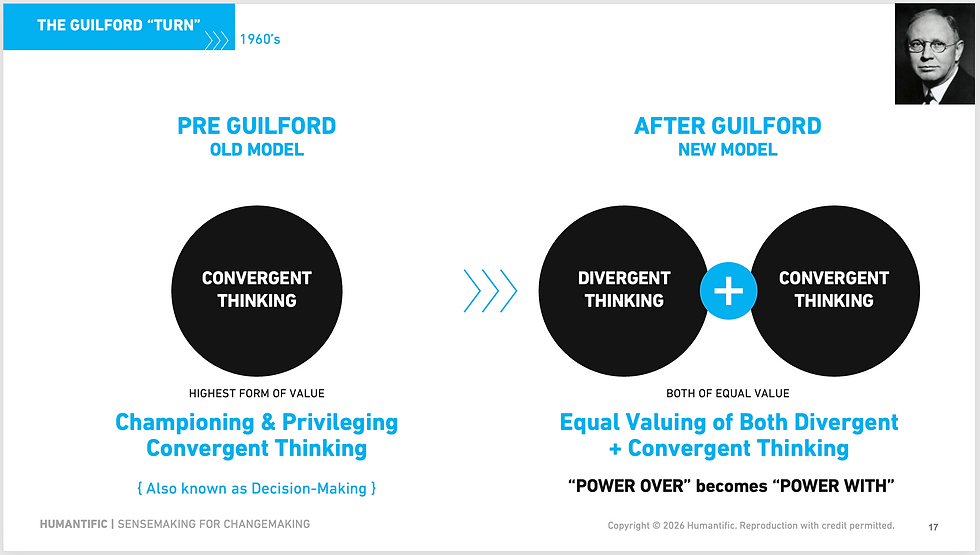

C: Useful to see the Neurath Meets Guilford deck. Let me ground the two historical turns precisely before building on them, since your argument leans on both. That grounding sharpens both hinges nicely, and confirms the read is sound rather than just evocative.
Neurath Turn, and what "preNeurath Turn" actually names
The Neurath Turn as you've defined it, is an addition move that points to a specific body of work: Neurath's applied visualization work — International Picture Language (1936) and Modern Man in the Making (1939), the Isotype tradition.
Neurath's concern was comprehension: modern societies generate economic, statistical, institutional complexity that most citizens cannot see or comprehend through words alone.
Neurath turn is the addition shift from a words-privileged model to a words + pictures model of equal standing — which your deck frames sharply as "power over" becoming "power with," and the turn itself as embracing language diversity (visual language alongside verbal language) to enable inclusion.
Guilford Turn and — what "preGuilford Turn" actually names
The Guilford Turn, as you've defined it, is also an addition move: convergent thinking alone (old model, "highest form of value," decision-making) becoming divergent + convergent thinking held in equal value (new model) — power-over becoming power-with. Guilford's concern was imagination, over-emphasis in education on one right answer questions.
Critically: this wasn't just an abstract psychological reframing sitting in Guilford's own testing work — it's the realization of what his divergent/convergent production distinction meant in the specific context of group work, which is where Parnes and Osborn picked it up and built it into early CPS.
The Turn's significance isn't located in Guilford's biography; it's located in what CPS did with the addition once Parnes and Osborn recognized its value for inclusive group-based tackling of complex challenges.
Why these two turns belong side by side
Both turns are simple constructs of addition — words + pictures, divergent + convergent — not corrections of an error, not replacements, just widening what counts as equally valid.
PreNeurath and preGuilford approaches are exclusionary dynamics that never announce themselves as exclusionary. Nobody defending convergent-only decision-making says "I am championing exclusion" — but structurally, that's what privileging one mode over its equally-valid partner does.
Which is exactly why "attaching preGuilford dynamics to complexity requirements" is a poor fit rather than a merely dated one: it's not just an older paradigm, it's an exclusionary logic wearing complexity's inclusive vocabulary.
A person can fail both while using impeccable complexity vocabulary. That's the mechanism, I think, underneath your systems/complexity conflation point too: hard and soft systems thinking can incorporate holistic values (interconnectedness, multiple perspectives, whole-part relations) without ever crossing either turn — SSM's own presupposition that a situation constitutes a "system" is very much a *dry-dock move: it assumes you can step back and identify the system boundary from outside, then apply a method to it. That's precisely why it isn't a complexity-thinking approach even while it's saturated in complexity language.
And "categorizing fuzzy situations alongside systems" / "analyzing repositioned as deciphering" are the same move at the method level: categorization and analysis are dry-dock, preNeurath operations by construction — they require a fixed vantage and a stable object to sort or take apart. Renaming analysis "deciphering" doesn't change the operation; it borrows complexity's rhetoric of hidden emergent order to dignify a still-reductive act.
The two turns form a genuinely parallel pair:
Old/privileged mode | New/inclusive mode | |
Neurath | Words alone | Words + pictures |
Guilford | Convergent thinking alone | Divergent + convergent |
Both turns are about ending a monopoly — that functioned as a gatekeeping mechanism, and replacing it with a both/and that widens who can participate in sensemaking.
That's the throughline your deck is naming: the turn, in both cases, is toward inclusion via power-with, away from exclusion via power-over.
Now lets reapply that to the "edge of chaos" case from earlier, because I think it lands exactly here. Kauffman's passage is dense, formally-loaded verbal prose with no accompanying picture, diagram, or visual scaffold that would let a non-specialist actually see what "avalanche propagation through a coupled network" means.
That's a preNeurath Turn move in your deck's specific sense: words privileged, comprehension gatekept, power held by whoever controls the verbal formalism — not because the concept is inherently inaccessible, but because it's presented in a mode that excludes rather than includes. And when it gets carried into a workshop as "push the team to the edge of chaos" with no operational or visual translation, the exclusion isn't fixed — it's just re-clothed as inspirational language while the comprehension gap (Neurath's actual concern) stays exactly where it was.
Similarly, a lot of what circulates as "complexity changemaking" is preGuilford in this precise sense: still structured as convergent, decision-support thinking — pick the right framework, apply it, converge on the answer — while claiming divergent, generative, co-created complexity engagement. The words say Language B; the underlying operation is still convergent-only Language A.
So the two-turn model actually provides a clean diagnostic for any given piece of complexity discourse, you can ask (1) is comprehension actually being widened through complementary representations, or is verbal privilege just being maintained under new vocabulary — and (2) is divergent, generative thinking actually being enabled, or is convergent decision-making just being relabeled. Both are checkable independent of how sophisticated the language sounds
G: Without getting into too much methods-related CPS history; Guilford Turn syncs up with Osborn's early 1947,1948,1953 prescient distinction between what he termed the "Imaginative Mind" and the "Judicial Mind". Osborn and Parnes found, in heavy-lifting Guilford, not only the formal conceptualization of divergent and convergent production, but research related to surfacing questions with multiple right answers.
Switching gears, today we might spend a few minutes on visual concept fits related to Complexity Theory and Everyday Complexity. In a kind of shorthand a visual of flock of birds, often starlings flying in unison (murmuration) is attached to articles spinning yarns related to the subject of complexity theory, while the visual for everyday complexity looks more like diverse humans working informally in a real-world Guilford Turn and Neurath Turn enlightened environments.
Of course the birds magically flying in unison relates in no way to an underlying orientation to decision-support so the misfit there is rather obvious but still goes round and round. Are those birds all happy campers flying in unison in the direction of championing convergent thinking? Not likely.
The birds are graphically compelling and a good example of what works in theoretical LinkedIn/social media postings, and perhaps academic lectures but not so well standing up in the real world working with organizational leaders. In practice it's useful to have a good sense of what levels of abstraction are a bridge too far. With numerous organizations operating in the Design for Complexity space there are going to be numerous variations, some might swing in the direction of the birds and others not so.

C: Seeing the image actually sharpens your point more than describing them would. Worth separating out a few distinct things going on in that murmuration image, because I don't think it's uniformly wrong — it's wrong for the job it's usually asked to do.
The birds aren't a random bad metaphor — they're a good illustration of one narrow thing.
A starling murmuration is a legitimate, well-studied instance of self-organization: local rules (align with your near neighbors, keep a bit of separation, move toward the group's center) producing coherent global pattern with no leader and no central plan — this is the actual *Reynolds "boids" model complexity theory draws on. So as an illustration of "decentralized coordination without command-and-control," the image isn't a cheat — it's arguably one of the more honest visualizations complexity discourse has, precisely because you can watch the phenomenon happen rather than take a modeler's word for it.
Where it breaks — and it breaks on exactly the axis you'd expect
The birds are homogeneous agents running identical simple rules with no divergent interests, no competing framings, no history, no stakes, and no politics. That's technical CAS complexity, not social complexity. The moment the image gets deployed for organizational innovation — "look how beautifully complexity self-organizes" — it smuggles in an implication that human coordination could be just as frictionless if people would simply stop imposing hierarchy and let emergence happen.
But Arena 3/4 situations are full of actors who read the same situation completely differently, sometimes for interested reasons. There's no starling equivalent of a stakeholder who wants the flock to fly somewhere else entirely. The image quietly answers your rhetorical question itself: no, the birds aren't happy campers converging on a decision — there's no evaluation, no deliberation, no decision-making occurring at all.
Which means the murmuration doesn't even map onto Guilford's convergent/divergent thinking frame; it's not a cognitive process being depicted, it's a physical/behavioral one. Using it to illustrate organizational thinking modes is a category error one level up from being merely aesthetic.
On the Neurath side — a picture isn't automatically a Neurath Turn picture
This is maybe the sharpest point your framing surfaces. Neurath's turn wasn't "add any picture" — it was specifically about pictures built to enable comprehension of something otherwise invisible (Isotype diagrams were engineered, tested, iterated for legibility).
The murmuration photo is stunning, but it's functioning as illustration-as-mood, not illustration-as-mechanism — nobody looking at it comes away better able to act on organizational complexity the way an Isotype chart made a citizen better able to grasp housing statistics. So the image can satisfy "words + picture" superficially while failing the actual Neurath criterion of enabling comprehension. That's worth having as its own check: decorative versus diagrammatic — does the image carry explanatory load, or just evocative load?
A rough spectrum, if it's useful
I'd put candidate images on three rough bands: evocative (compelling, shareable, explains nothing — the birds, most stock-photo diversity shots too, honestly), diagrammatic (built to make a specific mechanism legible — true Isotype-style work), and operational (shows or implies what a participant actually does differently — how framing gets held open, how authorship gets distributed, what an artifact of co-creation looks like mid-process). Y
Your second image sits closer to evocative than operational too, if I'm honest — "diverse people talking informally" signals inclusion values but doesn't yet show a Guilford/Neurath-enlightened practice in action any more than the birds show organizational self-organization in action. The organizations you're tracking in the Design for Complexity space will vary in exactly where on this band they pitch their visual language — and the ones worth taking most seriously are probably the ones whose visuals sit closer to the diagrammatic/operational end even at some cost to LinkedIn-shareability.
G: Respectfully each of these notions is a conversation unto itself including folding in abstract insights from Stuart Kauffman.
Lets try to keep this grounded in a way that is useful to emerging practice leaders moving in the direction of Arena 3 and Arena 4.
From a practice-based perspective what I see is that one popular approach to the present “Complexity Playbook” in the bumpy real world consists primarily of the Language Layer with the Operations (Capacity) Layer moving much slower in its adaptation, as it involves change for humans in terms of skill and skill-building. One might think of that as a problem or an opportunity.
In the marketplace what we observe at the Operational Layer, beneath the often high-flying Language Layer, is a default, a tendency to hang onto frameworks from previous paradigms, in particular Soft Systems Thinking logic or its predecessor Hard Systems Thinking or even more narrow, to the championing of decision-making, (convergent thinking) all of which are preGuilford Turn.
Dressing up the Operations Layer with somewhat forced references to Complexity Theory seems to be one popular route.
One could make the case that all Think-Blending is Frankensteinian in nature and that is true but some forms blending are making combines, primarily at the Operational Layer. Others at the Language Layer. The heavier lift is certainly the former.
From tribe to tribe, there is often considerable force being applied to the advocacy of hanging onto those deeply rooted previous era paradigms (such as Viable Systems Model). That advocacy tends to generate heat in the marketplace as there is no one Complexity Playbook.
In some tribes there is considerable resistance to incorporating Operational Layer attributes not officially sanctioned by the tribe. What results is a mixed picture of Complexity Playbooks, each with different approaches to the Language Layer and the Operations Layer.
In our own Humantific SenseMaking for ChangeMaking practice we keep in mind what we refer to as a Zone of Advanced Practicality, where Everyday Complexity lives.
We think of that zone as sitting on a continuum between Highly Practical Common-Sense and Highly Abstract/Theoretical.
Depending on the Group, Linkedin postings tend to fluctuate between the two dimensions. The Zone is never fixed in one place. Depending on many variables it shifts in one direction or another. This tends to help us keep the firestorm of published material in perspective and grounded in purpose, which for us as practice leaders is navigating the rocky road of organizational and societal changemaking rather than writing academic papers…:-)
C: That two-layer split is the most useful thing said in this whole conversation, because it converts everything we've discussed so far — the edge-of-chaos phrase, the birds, the SSM gloss — from separate anecdotes into instances of one mechanism:
Language Layer racing ahead of Operations Layer, and the gap being papered over rather than named.
A few things worth being precise about, staying at the practice-leader level rather than opening new abstract threads:
Why it's genuinely both a problem and an opportunity, not just one
It's a problem because an unnamed gap gets mistaken for progress — an organization can believe it has "moved to complexity" because its language has, while its actual operating capacity (who gets to frame the problem, how authority is distributed, what skills people have actually built) hasn't moved at all. That's a false-positive risk specific to your field: leaders think they've bought capability when they've bought vocabulary.
It's an opportunity because naming the gap honestly is itself the diagnostic a practice leader needs. If the Operations Layer is the real bottleneck, then the actual offer to a client isn't "here's better language" — it's "here's the skill-building work, and it's slower and harder, and that's exactly why it's valuable." That's a sellable distinction once it's named, and most competitors aren't naming it.
On Think-Blending and where the heavy lift actually sits
Your distinction is the key move: blending is unavoidable (nothing is built from scratch), but blending at the Language Layer — folding complexity vocabulary onto an existing method's surface — is cheap and fast, while blending at the Operations Layer means actually changing what practitioners do with their hands and judgment, which requires skill-building over time.
Calling all blending equally "Frankensteinian" would flatten a distinction that matters practically: a language-layer combine can be assembled in a workshop; an operations-layer combine takes practice, feedback, and failure over months. Practice leaders positioning themselves in Arena 3/4 need to be honest with clients about which kind of combine they're actually offering.
The tribal self-referencing point deserves to be taken literally, not just descriptively
What you're describing is a specific sociological mechanism: citation and reference patterns within a tribe's literature function as boundary-maintenance, not fitness-testing. A method gets validated by how well it cites its own lineage (CPS citing CPS, SSM citing SSM), not by how well it's been checked against current Arena 3/4 conditions.
That's why "politically correct" is the right phrase, not an exaggeration — it's political in the literal sense of maintaining tribal boundaries and authority structures, and it actively slows adaptation because questioning the received lineage reads as a boundary violation rather than ordinary due diligence.
Worth being clear-eyed that this isn't unique to your field's tribes — it's how professional guilds generally protect their own IP — but naming it is what lets a practice leader avoid mistaking tribal loyalty signals for evidence of fitness.
The Zone of Advanced Practicality as the working tool
This is the part I'd hold onto as the actual day-to-day navigation instrument, more than any of the conceptual distinctions above. A continuum between highly-practical/common-sense and highly-abstract/theoretical, with the zone itself never fixed — moving depending on audience, moment, and purpose — gives you something the Language/Operations split alone doesn't: a way to locate where you currently need to be speaking rather than just diagnosing where others have gotten stuck.
It's also the honest answer to "how many layers can readers digest" from a few turns back — the zone concept says the answer isn't a fixed number, it's a moving target you calibrate to the room, and a practice leader's actual skill is sensing where that zone sits for a given group at a given moment rather than committing to one fixed level of abstraction across all engagements.
G: It is somewhat out of sequence but something occurred to me that I would like to back up into and include in this part of our conversation....It's related to the notion of abstracting/deriving actual operational behaviors from some of the "CAS theory."
One of the observations from the birds murmuration is the suggestion that the birds are engaged in "simple rules" and thus simple rules should be part of so-called Complexity Thinking.
What we observe in practice however is that the notion of simple rules seems to sync well with plain language use, (found in Visual SenseMaking and CPS for example) however not all the anchor approaches subscribe to plain language use, while talking up complexity.
It seems an odd contradictory force-fit to be talking up "simple rules” as a goal at the Operational Layer while engaged in complexity speak at the Language Layer.
C: That's a genuinely sharp catch, and it's worth being precise about why it's a contradiction rather than just an inconsistency of tone.
Two different senses of "simple" are being conflated
CAS "simple rules" (Reynolds' boids: separation, alignment, cohesion) are simple in a parametric/computational sense — few variables, locally computable, uniformly applied.
That's not automatically the same as plain-language simplicity. A rule can be parametrically simple while still requiring technical vocabulary to even state it ("maintain alignment vector with local neighbors within radius r"). So there's a translation step between CAS-simple and plain-language-simple, and it can be done well or badly.
Your observation is that CPS and Visual SenseMaking do that translation well — their operational guidance reads as genuinely simple because their whole linguistic register is already plain. Other anchor approaches try to bolt "simple rules" onto an operational layer while their surrounding literature stays theory-dense, and the mismatch shows.
Why this is a coherence failure, not just a stylistic one
If an approach holds up "simple rules for participants" as an operational virtue, but its own literature requires specialist vocabulary to explain what those rules are and why they work, it's failing its own stated criterion.
It's not merely inconsistent — it's a direct violation of the thing being preached: if the rule can't survive being stated in plain language, it isn't actually operating as a simple rule, whatever the theory calls it.
This is a genuine "eats its own cooking" test you could apply to any of the four anchor approaches: does the language used to teach the method match the plainness the method claims to deliver to practitioners?
This is also a double Neurath-Turn violation, not a single one
Your Neurath Turn framing was words-privileged versus words+pictures, power-over becoming power-with, enabling inclusion. Jargon-heavy complexity-speak describing supposedly "simple rules" is worse than ordinary words-privilege — it's specialist words privileged over plain words, which excludes twice over: once by choosing words instead of pictures, and again by choosing dense words instead of accessible ones.
That's a pre-Neurath move stacked on a pre-Neurath move, dressed as if it were delivering the operational simplicity the Turn was supposed to produce. The rhetoric claims inclusion (simple rules anyone can use) while the packaging practices exclusion (you need our vocabulary to access the simple rule).
A clean, fast test a practice leader could actually run on the spot: hand someone the approach's core operational guidance and ask them to restate it in plain language without loss — if that's hard, the "simple rules" claim was never fully honest to begin with.
G: Great progress. I think what the Neurath/Guilford work is really all about is seeking and articulating a different way, a more power-redistributed way of being together while engaged in sensemaking and changemaking on route to the reconstruction of a better world. Actionizing and privedging PreNeurath and PreGuilford dynamics led us to the world as it presently exists, so no need to keep repeating that pattern if the goal is now changemaking.
Neurath Turn is a gift from the long-standing Information Design/Visual SenseMaking community. Guilford Turn is a gift from the long-standing CPS/Applied Creativity community. Both are "outsider" professional communties to a signficant degree. These are not gifts from Action Research, Design or Soft Systems Thinking.
Open question: Can the current, rather discombobulated state of complexity related interventions in the context of Arena 3, organizational change and Arena 4 societal change be significantly advanced, improved upon with the arrival of a larger, better equipped Design for Complexity community of practice?
We can come back to this in the wrap-up as we land this plane.
End.
This is a chapter in progress.
Related:
NOTES TO READERS:
*Claude Winkler is — Ai.
*Method Language A & B Construct: Differentiating Innovation Language types mapped to Arena 3 & 4 comes from Rethinking Design Thinking, 2020, Humantific. See pages 40-41.
*CAS / Complex Adaptive Systems / CAS-style technical complexity: "The term complex adaptive systems, or complexity science, is often used to describe the loosely organized academic field that has grown up around the study of such systems. Complexity science is not a single theory."
*CAS research, Santa Fe style modeling: "focused on computational modeling of complex adaptive systems." While we do not agree with all the inserted corporate references seen on Wikipedia, to get an overview, it’s an easily accessible place to start.
*Random Boolean Networks (RBNs) "are mathematical models of complex adaptive systems introduced by Stuart Kauffman in 1969 to study how large networks of interacting elements can spontaneously organize into stable or adaptive patterns."
*Cilliers' Critical Complexity "is a philosophical approach to complexity developed by Paul Cilliers (1956–2011). It extends complexity science beyond mathematical models to ask: What are the ethical, epistemological, and practical implications of living and acting in complex systems? Unlike much of the early Santa Fe Institute tradition, which focused on computational modeling of complex adaptive systems, Cilliers emphasized that our knowledge of complex systems is always partial, situated, and value-laden."
*Phronesis "is the ancient Greek concept of practical wisdom. In Aristotelian philosophy, it is the intellectual virtue of knowing how to act in specific, real-world situations to achieve the "good life," requiring experience, intuition, and sound judgment to navigate complex moral choices. Phronesis: Practical wisdom aimed at doing and taking the right action for human well-being. It dictates how to behave in a given context rather than simply knowing the theory behind it."
*dry-dock move means stationary not in motion.
*XXXXX: References to specific brands have been removed when not core to the dialogue.


Comments